Methods to Convert BTC to cbBTC on Base: 2026 Edition
Bitcoiner's Guide
If you want to get your Bitcoin onto Base as cbBTC; but you're not sure which method actually gives you the best deal. We did the legwork for you and ranked all options based on speed, cost, and slippage.
In this guide, we compare every working method to bridge native BTC to cbBTC on Base, not just the quoted rates, but the actual amounts received in wallet after fees, slippage, and the real time it took from sending Bitcoin to holding cbBTC. We tested each method with 0.001 BTC.
Method 1: Coinbase
The most straightforward way to get cbBTC is through Coinbase directly. Since cbBTC is Coinbase's own wrapped Bitcoin product, the platform handles the conversion natively with zero slippage.
How it works:
- Open the Coinbase app and tap Transfer → Send Crypto
- Select Bitcoin and enter the receiving Base wallet address
- Enter the amount and confirm
- Your BTC is automatically converted 1:1 to cbBTC and arrives in your Base wallet
When you send BTC from Coinbase to any address on Base, it converts automatically to cbBTC.
This method requires a Coinbase account with KYC verification. It's currently available in the US (excluding New York State), UK, EEA countries, Australia, and Brazil. If you hold your Bitcoin in self-custody and don't want to send it to a centralized exchange, this route isn't for you.
The Self-Custody Alternatives
If you plan to convert BTC to cbBTC entirely onchain without giving up custody of your funds to a third party, you have three options worth considering: Garden Finance, Symbiosis Finance, and Near Intents.
We tested all three with the same 0.001 BTC amount. Here's exactly what happened:
| Method | Amount Sent (BTC) | Amount Received (cbBTC) | Total Cost (USD) | Total Time Taken | Slippage |
|---|---|---|---|---|---|
| Garden | 0.001 | 0.0009979 | $0.14 | 26 seconds | Nil |
| Symbiosis | 0.001 | 0.000968 | $2.01 | 8 min 49 sec | 0.24% |
| Near Intents | 0.001 | 0.000995 | $2.05 | 12 min 38 sec | 0.2% |
Note: Test performed on February 12, 2026. Swap timing is highly dependent on Bitcoin block time, which averages 10 minutes, results may vary slightly.
Other cross-chain bridges like Across Protocol and Chainflip do not currently support Bitcoin to Base bridging, and Relay however showed a quote but did not work.
Method 2: Garden Finance
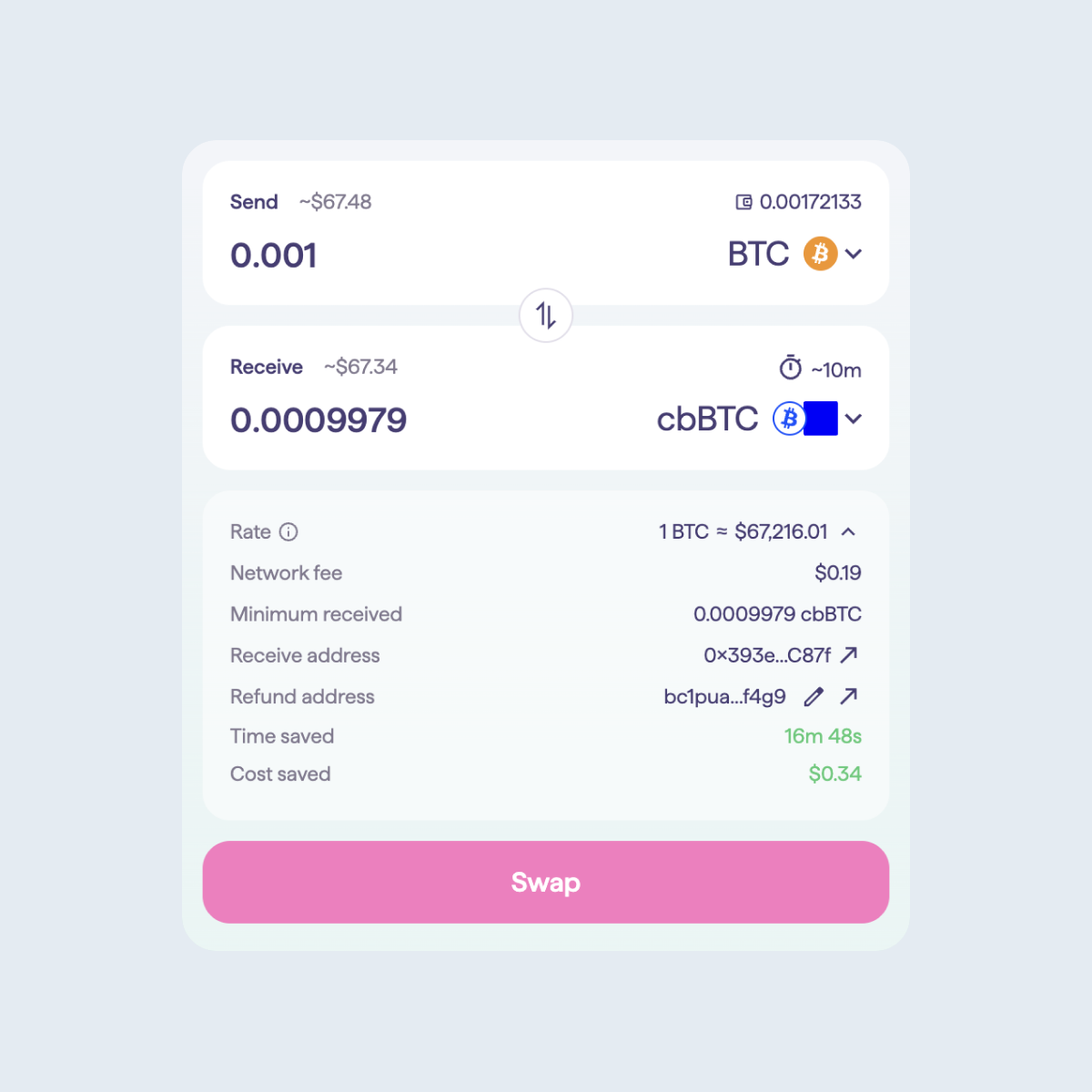
Garden Finance uses Hash Time-Locked Contracts (HTLCs) for atomic swaps, meaning the swap either completes in full or reverts, with no counterparty risk. It settled in 26 seconds and cost just $0.14.
The reason Garden consistently outperforms alternatives on time comes down to confirmations. Garden requires only one Bitcoin block confirmation before HTLC can release funds on the destination chain. Most other bridges wait for two or more confirmations, which directly doubles or triples the wait time.
Trust assumptions
Garden uses HTLCs for atomic swaps. Both sides of the swap are locked in contracts, if either fails to complete within the timelock window both revert automatically. No third party holds your funds at any point.
Transaction proofs:
- Bitcoin: mempool.space/tx/eed3aa11f2a149a6c1249230c3aea2cc9f2d287592bd3803433b2e79229181bc
- Base: basescan.org/tx/0xbe6be8e0bcf1c62e91fb82aee1929f01d21e2de975403a888006d5bd4f3cfa0d
Method 3: Symbiosis Finance
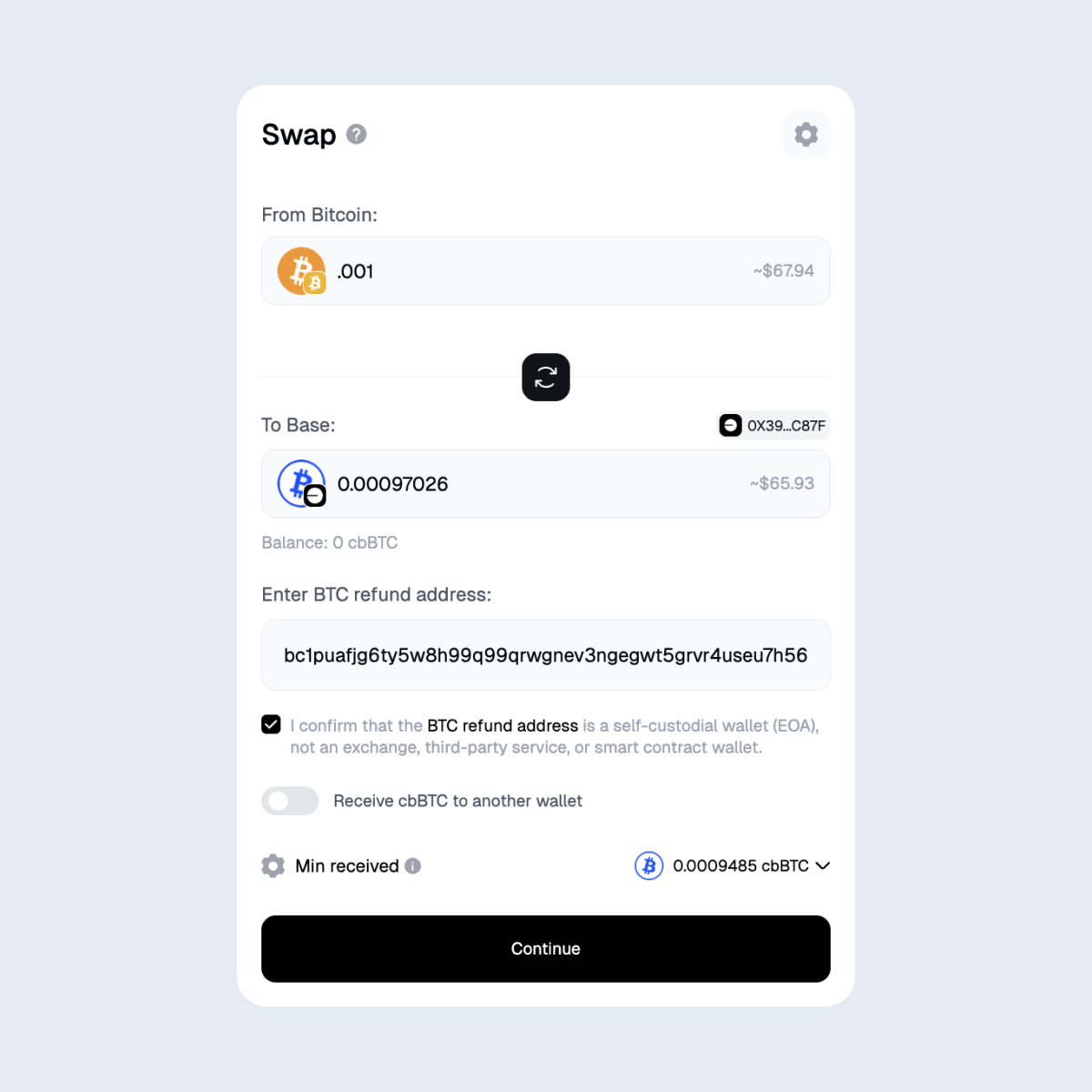
Symbiosis completed the swap in 8 minutes 49 seconds at a cost of $2.01, with 0.24% slippage, meaning you receive slightly less cbBTC than the quoted amount.
One significant usability issue: Symbiosis does not support direct Bitcoin wallet connection. The process is entirely manual you need to copy a Bitcoin address shown on screen, send Bitcoin to it yourself, and then wait for confirmations. There's no "connect wallet and swap" experience here. The bridge waits for two Bitcoin block confirmations before processing the Base side of the transaction, which accounts for most of the wait time.
Trust assumptions
Symbiosis uses an MPC relayer network where a valid signature requires at least two-thirds of the validator group, plus a Veto group that must co-sign every transaction. You are trusting that a supermajority of validators and the Veto group act honestly.
Transaction proofs:
- Bitcoin: mempool.space/tx/e3cfd46338f9f79eb161a68f84cea41a80775200ad46f02fea7b7cfd746abf76
- Base: basescan.org/tx/0x4485ac42e6e19665f44bf20dbd72f4bd81e5fc7094ce64e0f3438ce2f1a3cc3e
Method 4: Near Intents
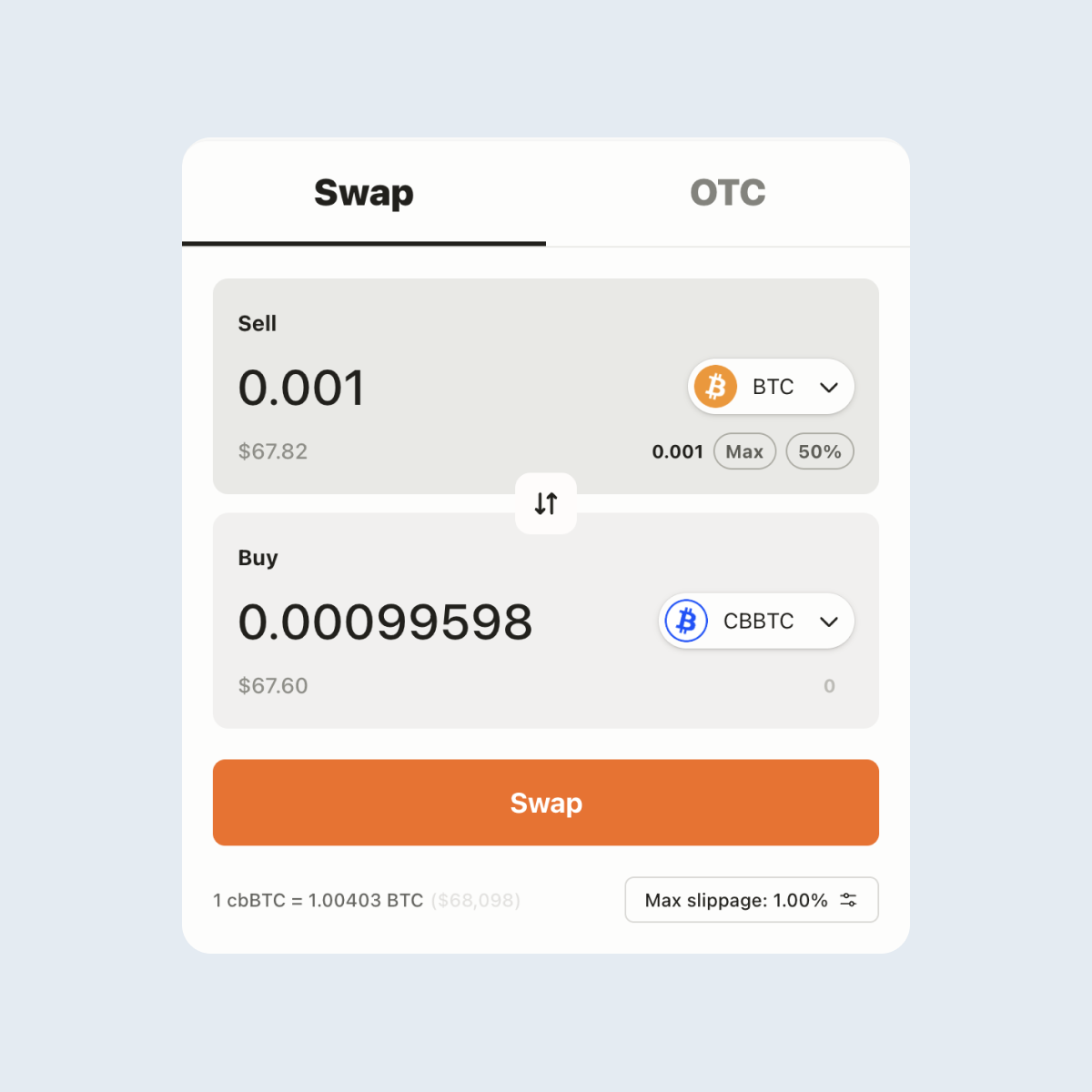
Near Intents completed the swap in 12 minutes 38 seconds at a cost of $2.05, receiving 0.000995 cbBTC for 0.001 BTC sent.
The process is notably more complex than the others. Near Intents follows a deposit-and-trade model rather than a simple connect-and-swap flow. You first need to deposit funds into a Near Intents account, then separately place the bridge transaction. For users who aren't already familiar, the onboarding adds meaningful friction on top of the already longer wait time.
Trust assumptions
For Bitcoin deposits, Near Intents uses a Proof-of-Authority (PoA) bridge to bring BTC onto NEAR before the intent system begins; meaning your Bitcoin first passes through a trusted bridge operated by a set of authorized entities. Once on NEAR, assets are temporarily transferred to a trusted swapping agent that coordinates with market makers to execute the intent. The multi-step flow, PoA bridge, trusted swapping agent, and off-chain solver network involve more intermediary layers than the other methods tested.
Transaction proofs:
- Bitcoin: mempool.space/tx/e6db07ca98412feb367c0c23ecd6772762602bac5a8150e5b0b62284480c32bf
- Base: basescan.org/tx/0x8e3796f83d780576a33945b15fb341f7e4097ac6295d3fce9eb7ba6ecfb8a447
| Method | Custody Model | Trust | Risk |
|---|---|---|---|
| Coinbase | Custodial, centralised | Coinbase (centralized) | Coinbase is hacked or insolvent |
| Garden Finance | Non-custodial, atomic swaps | No one, enforced by HTLCs | Bitcoin or Base network fails |
| Symbiosis | Non-custodial, MPC network | 2/3+ of the validator/MPC group | Supermajority of validators/MPC collude |
| Near Intents | Custodial, trusted swapping agent | PoA bridge operators + swap agents | PoA bridge operators or swap agents act maliciously |
The Bottom Line
If you have a Coinbase account, the official route gives you a guaranteed 1:1 conversion with no slippage. It's the simplest option but requires KYC and giving up self custody.
For anyone bridging BTC to cbBTC without touching a centralized exchange, Garden Finance is the clear winner across every metric tested: fastest settlement at 26 seconds, lowest cost at $0.14, and easiest swap flow.
Last updated